SAP integration that connects the landscape end-to-end
Fragmented integrations are the hidden cost of every SAP landscape. BCS designs, builds, and manages integration architectures on SAP Integration Suite, replacing brittle point-to-point connections with governed, observable, and maintainable integration patterns that survive upgrades and scale with the business.
30-minute discovery session.
SAP ends mainstream PI/PO maintenance in December 2027, with extended support to 2030 (SAP).
Majority of legacy SAP integrations require rework during S/4HANA migration due to PI/PO design assumptions (Gartner).
Typical SAP integration decisions involve 22 stakeholders across IT, finance, operations, procurement (Forrester).
Integration that connects, orchestrates, and operates autonomously
Most enterprises treat integration as plumbing. BCS treats it as an intelligent layer that detects failures, reroutes flows, and resolves issues without human intervention, connecting every SAP and non-SAP system across your enterprise.
As the world's first Agentic System Integrator, BCS deploys Symphony across every integration programme BCS delivers. Symphony monitors every interface in real time, surfaces failures before they reach operations, and triggers automated resolution. Your teams stop firefighting broken interfaces and start running an enterprise that operates itself.
The integration failure modes that cost organisations most
Integration debt accumulates silently. A migration, an acquisition, or a system upgrade eventually exposes how fragile the landscape has become. Every failure pattern below is one BCS has seen repeatedly, and is designed to prevent before the first interface is built.
What a well-integrated SAP landscape delivers
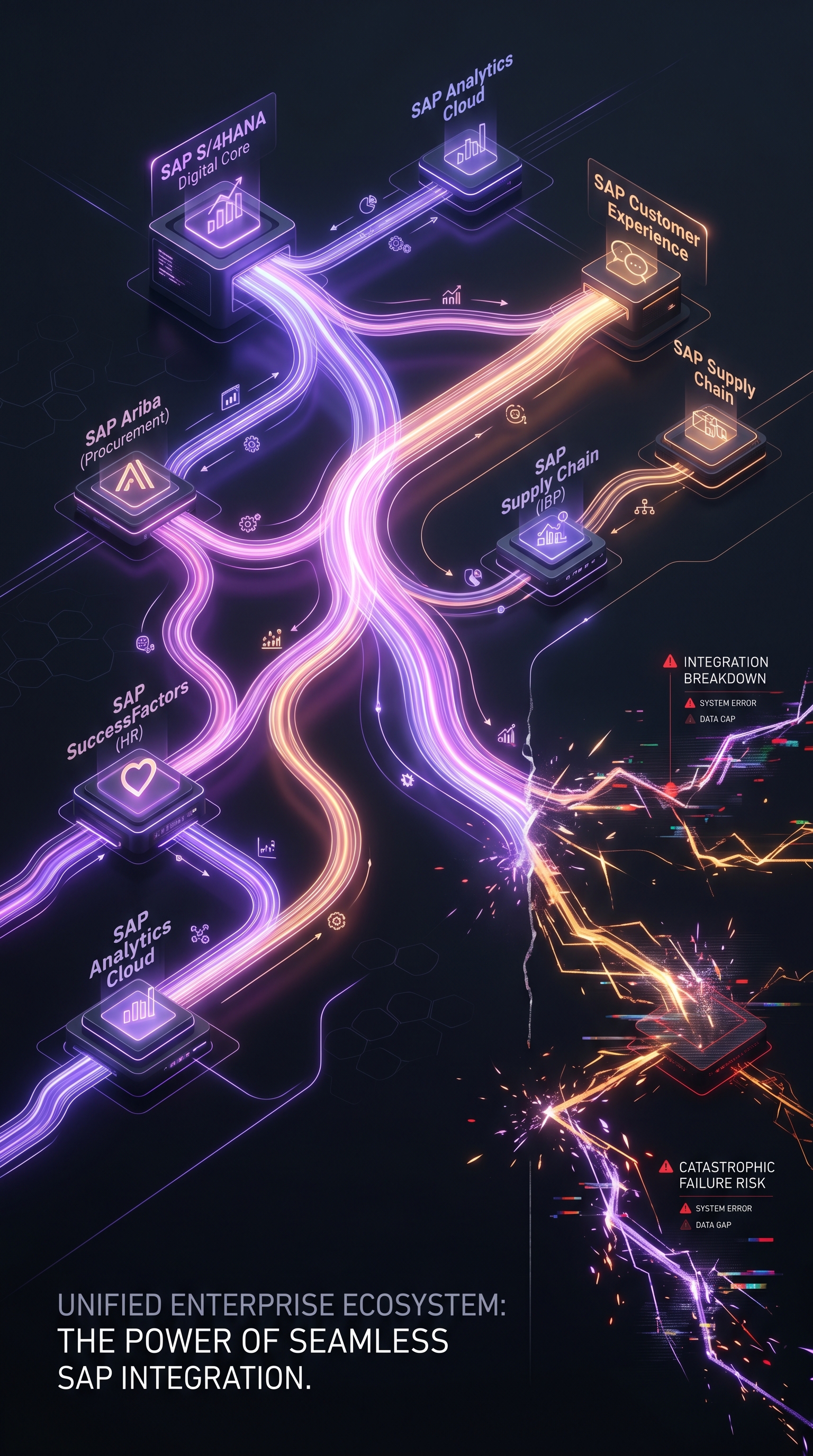
Integration is invisible when it works and catastrophic when it does not. A properly architected SAP Integration Suite landscape removes manual reconciliation, compresses process cycle times, and gives the business a single consistent data set across every connected system.
One version of operational truth
When SAP, third-party logistics, CRM, and e-commerce systems exchange data reliably through governed integrations, the business operates on a single consistent data set, not multiple versions reconciled manually.
Faster process cycle times
Automated, reliable integrations remove the manual data transfer and re-keying that stretches process cycle times. Order-to-cash, procure-to-pay, and record-to-report run faster when the handoffs are automated.
Upgrade and migration readiness
A governed SAP Integration Suite architecture is designed to survive SAP upgrades, migration events, and third-party system changes. The integration layer becomes an asset, not a liability.
Reduced compliance and audit risk
Anugal monitors integration data flows for anomalies, data quality violations, and cross-system reconciliation gaps, surfacing compliance risks before they appear in an audit.
Operational visibility across systems
deKorvai surfaces cross-system analytics by aggregating data from integrated systems, demand signals, supplier performance, and financial positions visible in a single intelligence layer.
Lower integration maintenance cost
Standardised, governed iFlows maintained through SAP Integration Suite's lifecycle tooling require a fraction of the effort to maintain compared to bespoke middleware or direct API connections.
How does BCS design and deliver SAP integrations?
BCS integration programmes follow a five-phase approach from landscape assessment to live operations. Every iFlow is built to a governed standard with error handling, monitoring, and regression testing included from build, not bolted on at the end.
Assess and Discover
BCS profiles the existing integration landscape, message volumes, and interface complexity. For PI/PO migrations, SAP Migration Assessment automatically classifies which interfaces can convert to CPI on an automated path.
Architecture and Design
The target SAP Integration Suite architecture, governance model, API strategy, error-handling design, and monitoring framework are defined. iFlow naming conventions and transport landscape are agreed before build begins.
Build and Test
iFlows are developed using BCS pre-built CPI templates and tested against target SAP and non-SAP systems. The integration regression test suite is established as a delivery artefact, not an afterthought.
Go-Live and Cutover
Parallel run validates the new integration estate against the legacy PI/PO landscape. Cut-over retires legacy interfaces only after BCS-deployed monitoring dashboards confirm clean message flow in the new platform.
Operations and Optimisation
BCS-managed integration operations run with Symphony-augmented incident detection and deKorvai anomaly analysis across data flows. Performance tuning is a continuous discipline, not a follow-on engagement.
Integration expertise across the SAP technology stack
BCS integration practice covers every layer of the SAP integration landscape, from PI/PO migration and SAP Integration Suite build to BTP API management, event-driven architecture, and ongoing managed operations with Symphony-augmented monitoring.
SAP Integration Suite (CPI) Development
Full SAP Integration Suite implementation, iFlow development, adapter configuration, mapping, value mapping, and exception handling. BCS pre-built iFlow template library compresses build time by 50% on common interface patterns.
PI/PO to CPI Migration
Full PI/PO landscape assessment and migration programme. SAP Migration Assessment and Migration Cockpit for automated migration, BCS development for complex interfaces requiring redesign. Parallel run and decommission managed as a single workstream.
BTP API Management
API-first integration design using SAP BTP API Management. API gateway configuration, rate limiting, security policies, developer portal, and analytics. Internal and external API governance programmes.
Event-Driven Architecture
SAP Event Mesh and event-driven integration patterns for high-volume, near-real-time integration scenarios. Event-based order processing, inventory updates, and supply chain signals.
Integration Monitoring & Operations
SAP Integration Suite monitoring, alerting, and SLA dashboards. BCS-managed integration operations with structured incident management and proactive performance monitoring.
Integration Security & Governance
OAuth2, certificate management, credential store, and integration governance. Naming conventions, transport management, and change control for enterprise integration landscapes.
Third-party Connector Library
Pre-built BCS connectors for Salesforce, Workday, ServiceNow, Microsoft 365, logistics providers, and banking APIs. Standard integration patterns for common enterprise system combinations.
Integration Testing Automation
Automated regression testing for integration scenarios using SAP Cloud ALM and BCS test frameworks. Regression suites that protect integration quality across SAP upgrade cycles.
Legacy Middleware Decommission
Structured decommission of SAP PI, PO, and non-SAP middleware after migration. Interface retirement inventory, dependency analysis, and parallel run management.
What other SAP integration partners cannot offer
BCS brings three proprietary platforms that no traditional integration partner can match. Symphony automates operations, deKorvai surfaces cross-system intelligence, and Anugal embeds continuous compliance, each working across your integrated SAP landscape from the day you go live.
 Agentic Operations Platform
Symphony
Symphony agents are deployed across the integrated SAP landscape at go-live, autonomously detecting integration errors, reprocessing failed messages, and routing cross-system exceptions without human triage.
- Automated integration error detection and reprocessing
- Autonomous alerting and incident routing without human triage
- Self-healing integration flows for common failure patterns
- Operational monitoring and SLA reporting without manual dashboards
 AI Decision Intelligence
deKorvai
deKorvai aggregates intelligence across the integrated SAP landscape, surfacing cross-system anomalies, integration performance trends, and demand signals from SAP and connected third-party systems.
- Cross-system analytics aggregated from integrated data flows
- Anomaly detection across integrated transaction volumes
- Demand and supply signal aggregation from third-party systems
- Integration performance analytics and throughput trending
 Compliance & Controls Automation
Anugal
Integrated SAP landscapes expand the compliance surface significantly. Every data flow crossing a system boundary carries audit risk. Anugal monitors cross-system data consistency, validates regulated data flows against compliance rules, and generates traceable audit evidence for transactions that span SAP and connected third-party systems.
- Cross-system data reconciliation and compliance monitoring
- Integration data quality validation against master data rules
- Audit trail generation for regulated data flows
- Compliance reporting across integrated system boundaries
Frequently Asked Questions
Refer to this section for answers to frequently asked questions related to SAP integration.
SAP Integration Suite versus PI/PO, which is the right target for new integrations?
How does BCS handle integrations with non-SAP systems?
What is the role of MuleSoft or Boomi alongside SAP Integration Suite?
Point-to-point versus event-driven architecture, which is right?
How does BCS govern integrations after go-live?
What makes BCS different for SAP integration?
Integration quality is invisible until it fails. These are the structural differences in how BCS designs, builds, and operates SAP integration programmes compared to the standard delivery model most enterprises have experienced and been burned by.
Governance before build
Naming conventions, transport landscape, error handling standards, and monitoring framework are defined before the first iFlow is written. Integration debt starts at zero and stays there.
Templates compress the timeline
BCS pre-built iFlow templates cover the most common SAP integration patterns, order processing, goods receipt, financial postings, HR replication. Build starts from a tested baseline, not a blank canvas.
PI/PO migration as a single workstream
BCS delivers PI/PO to CPI migration concurrent with S/4HANA programmes, eliminating the second-wave disruption of a separate middleware migration project.
Error handling is a design requirement
Every BCS iFlow includes structured error handling, dead-letter queuing, and alerting as delivery standards. Silent failures do not reach production.
Operations built in from day one
Monitoring dashboards, SLA reporting, and Symphony-augmented incident management are part of the integration delivery, not a follow-on engagement.
API strategy, not just integrations
BCS designs integration programmes within an API governance framework, internal developer portals, versioning, and deprecation policies that prevent the next generation of integration debt.
Ready to build an integration layer that lasts?
Tell BCS about the integration landscape, new SAP deployment, PI/PO migration, or a third-party connectivity programme, and BCS will scope an approach that delivers reliable, governed integrations from day one.
30-minute discovery session.